National Science Day
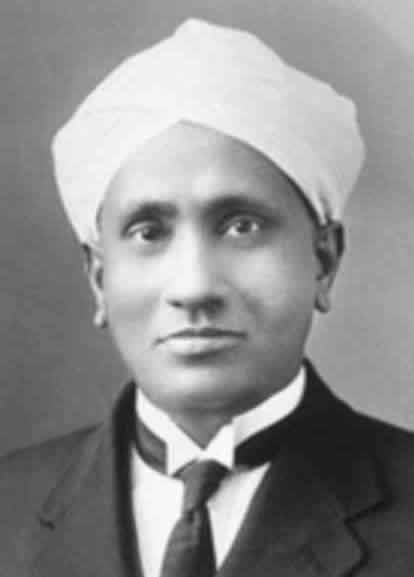 February 28 is celebrated as India's National Science Day to commemorate Chandrasekhara Venkata Raman's announcement of the discovery (in 1928) of his Nobel Physics Prize winning work (in 1930) on the scattering of light and for the discovery of the effect named after him.
Raman effect refers to the apearance of additional lines in the spectrum of monochromatic light that has been scattered by a transparent material medium.
The energy and thus the frequency and wavelength of the scattered light is changed as the light either imparts rotational or vibrational energy to the scattering molecules or takes energy away. The line spectrum of the scattered light will have one prominent line corresponding to the original wavelength of the incident radiation, plus additional lines to each side of it corresponding to the shorter or longer wavelengths of the altered portion of the light. This Raman spectrum is characteristic of the transmitting substance. Raman spectrometry is a useful technique in physical and chemical research, particularly for the characterization of materials.
C. V.
 Raman is the uncle of Dr. Subrahmanyan Chandrasekhar, another Indian - American Nobel Physics Prize winner (1983) for his studies on the physical processes related to the structure and evolution of stars. In 1999, NASA named the third of its four Great Observatories after Chandrasekhar known to us as Chandra X-ray Observatory.
C.V Raman's victory was the first time that an Indian scholar who studied wholly in India received the Nobel Prize. An interesting anecdote goes that he booked his tickets to Stockholm several months before the Nobel prizes were announced. When he was offered a toast during the Nobel function: Being a strict teetotaller, he responded, "Sir, you have seen the Raman effect on alcohol; please do not try to see the alcohol effect on Raman."
posted by optimism at 11:10 AM


2 Comments:
This comment has been removed by a blog administrator.
This comment has been removed by a blog administrator.
Post a Comment
<< Home