Survival of the Fittest
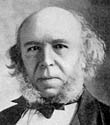 I admire Herbert Spencer's sociological works and was saddened to know about his personal life. For the man who coined the slogan of life itself (survival of the fittest that is), his own mere survival was well, not befitting a man of his calibre.
Looking at his face, I am reminded of what I recently read (and disagree with still). It is what Javier Marías writes in Written Lives (courtesy VJ)
It is as if the books we still read felt more alien and incomprehensible without some image of the heads that composed them; it is as if our age, in which everything has its corresponding image, felt uncomfortable with something whose authorship cannot be attributed to a face; it is almost as if a writer's features formed part of his or her work. Perhaps the authors of the last two centuries anticipated this and so left behind them numerous portraits, in paintings and in photographs...
Don't they say that looks can be deceptive?? or maybe I am particularly hopeless when it comes to forming right impressions of people I see or meet. Anyways, Spencer was the first person to have expressed the idea in the mid 1850s that the factor of evolution is present in not only science but also economics, philosophy, sociology and psychology. Almost forty years old then and in poor health, he set upon to devote his life to this grandiose project in scholarship. Closer home, he prepared himself to migrate to New Zealand for what he called "better luck under fairer skies", looking forward to not only a more profitable living wage but also "prospective excitement in marriage" but sadly to no avail. Many years later he wrote, "It seems likely that this abnormal tendency to be critical has been a great factor in the continuance of my celibate life."
Following in the footsteps of Auguste Comte, he formualted the basic principles of what he called his "synthetic philosophy" and this exposition, applied to all scientific fields, eventually grew into a work of eighteen volumes. It is believed that no other person of the nineteenth century had the energy or tenacity to undertake or complete such an immense project. Considered to be one of the most talked-of-men in England when the controversy on evolution was at its peak, his mind is said to be utterly closed to any idea that was not his own. One of his friends in fact remarked on his obsession with synthetic formulas for life that he stopped living and another said that he was all brain and no heart.
During the early years of his writing career, he drove himself without letup. At thirty-five he began to have peculiar sensation in the head and to experience severe insomnia. These reactions preceded a general nervous breakdown, from which he never recovered completely.
Whatever the cause, Spencer's boastfulness of his utter lack of emotion indicated one of his greatest weaknesses. He had no understanding of that part of life which "mind cannot regulate but the heart must feel." His interest in Phrenology - the study of the shape and protuberances of the skull, based on the now discredited belief that they reveal character and mental capacity - is said to have outstripped his emotions. "Usually heads have,here and there, either flat places or slight hollows, but her head was everywhere convex", is the only comment he wrote about his old friend Marian Evans (the famous writer George Eliot) and believe it or not, their mutual friends expected an engagement between them!
He lived until eighty-three in spite of his illnesses alone in pathetic desolation defending his views against hostile attack from scientists, religious leaders (he was known as the spokesman of the age of agnosticism), British imperialists (for being a critique of powerful state control) , socialists, et al.
Sigh.. and I thought this stalwart lived a wholesome life! This just goes to show that you think you know people but in reality you know only what they want you to know or what you perceive (duly added courtesy the comment by VJ) or that's what I think.
posted by optimism at 12:01 PM


1 Comments:
interesting point there, Optimism. I would like to rephrase this a bit without taking away from your moot point:
You think you know people but in reality to know only what they want you to know or that's what I think.
more than what they want you to know, I think it is what you expect from those faces (as in a reflection of your needs, if i may, on others) is what you come to see.
Post a Comment
<< Home